


Self-Confidence: Learning to Trust Yourself
Self-confidence is often described as "believing in yourself". While this sounds reassuring, it only tells part of the story. We often think of confidence as something built through success, ability, or achievement. Yet, many capable people continue to doubt themselves while others appear highly confident despite feeling deeply insecure beneath the surface. Perhaps the more meaningful question is not whether we believe in ourselves, but what allows us to trust ourselves.
Perhaps the more meaningful question is not whether we believe in ourselves, but what allows us to trust ourselves.
From a psychodynamic perspective, self-confidence develops through much more than our accomplishments. It grows out of our earliest relationships and emotional experiences, shaping how we see ourselves, how we relate to others, and whether we feel able to cope with life's inevitable challenges. Over time, these experiences become part of our inner world, influencing not only how we feel about ourselves but also how we interpret the situations we encounter.
Where self-confidence begins
Psychodynamic theory suggests that our earliest relationships lay the foundations for our sense of self. When caregivers are consistently loving, emotionally available, and responsive, children gradually develop an inner sense of safety. They begin to trust that they are worthy of care, that difficult feelings can be tolerated, and that mistakes do not diminish their value.
These experiences become internalised, forming the basis of self-trust. Healthy confidence is therefore not about always feeling certain or fearless. It is the quiet belief that even when life feels uncertain, we can learn, adapt, repair, and find our way through.
When early relationships are inconsistent, critical, emotionally unavailable, or neglectful, a different experience of self may begin to develop. Instead of feeling secure, individuals may become overly cautious, fear making mistakes, or depend heavily on the approval of others. Feelings of inadequacy, shame, or self-doubt often have their roots in these early emotional experiences.
Over time, these experiences also shape the beliefs we hold about ourselves and others. Someone who has repeatedly felt accepted may gradually develop a sense that they can cope with life's challenges. Someone whose experiences were marked by criticism or unpredictability may come to expect failure, rejection, or disappointment, even when there is little evidence that these outcomes will occur. These patterns often operate quietly in the background, influencing how we understand ourselves without us even realizing it.
When confidence feels fragile
Low self-confidence is rarely a sign of weakness or lack of ability. More often, it reflects the ways we have learned to protect ourselves emotionally.
The harsh inner critic many people experience is often more than ordinary self-criticism. From a psychodynamic perspective, it can represent internalized experiences from earlier relationships, where approval may have felt conditional or mistakes were met with criticism rather than understanding. Over time, this critical voice can begin to feel like an unquestionable truth rather than one possible way of seeing ourselves.
When confidence is low, we may hesitate before making decisions, avoid opportunities, question our abilities, or withdraw from situations that feel exposing. Feelings of anxiety, shame, helplessness, or confusion can become difficult to tolerate. Yet these reactions often make sense when we understand them as attempts to protect us from inner conflict and emotional pain rather than evidence that something is wrong with us.
Sometimes, however, protection takes a very different form.
When confidence becomes overcompensation
Overconfidence is often mistaken for simply having "too much confidence." In psychodynamic terms, this means that it can sometimes serve as a defense mechanism against feelings of vulnerability, inadequacy, or shame.
When acknowledging these painful feelings feels too overwhelming, we may unconsciously move towards the opposite extreme. We may appear unusually certain, dismiss feedback, overestimate our abilities, or feel driven to prove ourselves. Although this can create a temporary sense of control, it often masks a more fragile sense of self.
Like low confidence, overconfidence can make genuine growth difficult. If self-doubt keeps us from taking opportunities, overconfidence can prevent us from recognizing our limitations, learning from others, or reflecting on our experiences.
Neither extreme reflects genuine self-confidence.
Healthy confidence allows us to recognize both our strengths and our limitations without either defining our worth.
Therapy and building self-confidence
Coming back to the opening question, self-confidence cannot simply be reduced to "believing in yourself". While encouragement and practical advice certainly have their place, they rarely address the deeper emotional experiences that shape how we relate to ourselves.
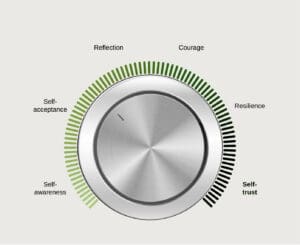
Many people who come to therapy already know what they "should" be doing. They know they need to speak up more, stop comparing themselves with others, apply for the job, set healthier boundaries, or let go of perfectionism. Yet, understanding these things intellectually does not necessarily make them emotionally possible.
The question to be asked is not "What should I do” but "What makes this so difficult for me””.
Psychodynamic therapy approaches confidence with curiosity rather than correction. Together, therapist and client begin to explore how earlier relationships, emotional experiences, and unconscious patterns continue to influence present-day life.
As understanding deepens, people often begin to realise that the critical voice they have lived with for years is not simply "who they are," but part of an emotional history that has shaped how they see themselves. Thoughts that once felt like unquestionable truths can gradually be understood as reflections of earlier experiences rather than objective facts. This creates space for greater curiosity, compassion, and choice.
The aim is not to replace negative thoughts with positive ones or to convince someone that they should feel confident. Rather, it is to develop a more realistic, compassionate, and integrated relationship with oneself. In other words, just a matter of tuning up the confidence level.
Learning to trust yourself
Healthy self-confidence rarely develops by trying to eliminate fear. More often, it grows through repeated experiences of facing uncertainty, tolerating discomfort, reflecting on what happened, and discovering that we are more capable than we imagined. This is what I think earned confidence is.
La confianza ganada se desarrolla de forma gradual. Crece cada vez que vivimos una experiencia que cuestiona, de manera amable, las antiguas expectativas que tenemos sobre nosotros mismos. Quien cree que no es capaz puede descubrir que sabe afrontar una conversación difícil. Quien teme el rechazo puede comprobar que expresar una necesidad no siempre conduce al abandono o a la crítica. Estos momentos pueden parecer pequeños, pero fortalecen poco a poco la confianza en uno mismo.

Instead of asking ourselves"How can I become more confident”, it may sometimes be more helpful to ask:
- What am I expecting will happen here?
- Where might those expectations have come from?
- Am I responding to what is happening now, or to something that feels familiar from much earlier in my life?
Questions like these move us away from self-judgement and towards self-understanding.
This does not mean that action is unimportant. Confidence still develops through experience. We build confidence by trying, making mistakes, learning, adjusting, and trying again. The difference is that our actions become supported by growing self-understanding rather than driven by self-criticism or the need to prove ourselves.
Over time, confidence becomes less reliant on success and less vulnerable to setbacks. It transforms into a quiet trust in our capacity to face difficulties, reflect on our experiences, repair what has been damaged, and continue growing.
Finding the middle ground
Many people experience confidence as a pendulum swinging between two uncomfortable positions. At one end lies self-doubt: shrinking ourselves, hesitating, and fearing mistakes. At the other lies overcompensation, i.e. feeling the need to appear certain, capable, or always in control.
Neither position offers lasting security. However, swinging from one position to other is just a reflection of a painful inner conflict.
Healthy confidence allows us to acknowledge our abilities without exaggerating them and our limitations without allowing them to define us. It leaves room for vulnerability, reflection, and growth.
Perhaps this is what genuine self-confidence has always been —not the absence of fear, but the willingness to remain connected to ourselves despite it.
Final thoughts
 Self-confidence is not something we either possess or lack. It is something that continues to develop throughout our lives, shaped by our relationships, our emotional experiences, and the meaning we make of them.
As we begin to understand ourselves with greater curiosity rather than judgement, confidence becomes less about appearing certain and more about trusting ourselves. We no longer need to shrink in the face of uncertainty or overcompensate to protect ourselves from it.
Perhaps genuine self-confidence is not about believing that nothing will go wrong. Perhaps it is about knowing that whatever life brings, we do not have to abandon ourselves. In other words, it is not about becoming someone else, but about learning to stay connected to yourself.
That quiet sense of self-trust —not perfection, fearlessness, or superiority— is where lasting confidence begins.
True self-confidence isn't about appearing stronger than others. It's about developing deep enough roots that you don't need to prove your worth.
Psychodynamic psychotherapy offers a space to explore the deeper emotional roots of self-confidence, helping you develop lasting self-trust. If you would like to explore this further, please send me a message through the contact page.